
Why intent matters more than the keyword itself
Two searches can share almost identical wording and mean completely different things. “Best coffee maker” could come from someone starting to research options, or someone who’s already narrowed it down and wants a final recommendation before buying. The words barely change; the intent behind them can be very different. Google’s ranking systems have learned, from an enormous volume of real search and click behavior, what searchers actually want for a given phrase, even when the phrase itself is ambiguous on its own.
This is why a technically well-optimized page can still fail to rank. If the content type doesn’t match what Google has already learned searchers want for that term, no amount of keyword placement or internal linking fixes it. I’ve seen well-written, well-structured blog posts stall permanently because the term they targeted consistently returns product pages, category pages, or tools, not articles. The content quality wasn’t the problem. The content type was.
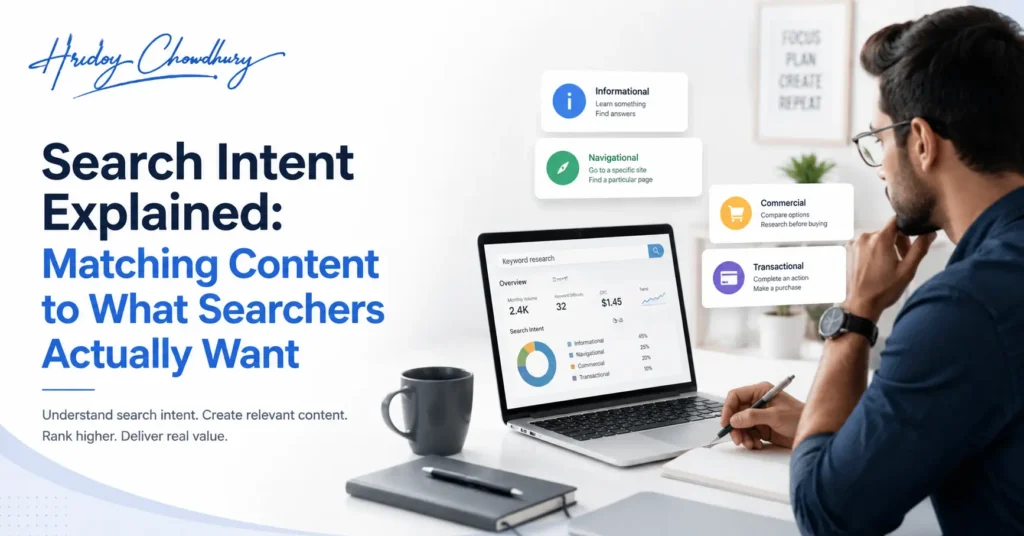
The four main types of search intent
Informational intent
The searcher wants to learn something, not buy or navigate anywhere specific. “How does compound interest work,” “what causes a sore throat,” “history of the Eiffel Tower.” These searches are usually best served by guides, explainers, definitions and how-to content. Informational intent covers the largest share of searches overall, and it’s usually the easiest starting point for a new site, since competition often includes more genuinely thin or outdated content than commercial categories do.
Navigational intent
The searcher already knows where they want to go and is using search as a shortcut to get there. “Facebook login,” “Nike official site,” “Ahrefs pricing page.” You generally can’t compete for navigational searches aimed at another specific brand, and there’s usually no reason to try. The relevant version for your own business is making sure your own brand name reliably surfaces your own site first, which is more about basic technical SEO and brand presence than content strategy.
Commercial investigation intent
The searcher is comparing options before making a decision, further along than pure research but not ready to act yet. “Best budget laptops 2026,” “Ahrefs vs Semrush,” “running shoe reviews.” This intent rewards comparison content, reviews, and buyer’s guides that genuinely help someone choose, rather than pages that simply promote one option without acknowledging trade-offs. Search engines and readers both tend to trust comparison content more when it’s honest about a product’s or approach’s weaknesses, not just its strengths.
Transactional intent
The searcher is ready to act now: buy, sign up, book, download. “Buy running shoes size 10,” “book dentist appointment near me,” “download invoice template.” These searches want a direct path to completing the action, a product page, a service page, a booking form, not an article explaining the general topic. Burying a transactional search behind a long informational blog post usually frustrates the searcher and underperforms, even if the writing itself is good.
How to check intent before you write anything
This is the practical habit that matters more than memorizing the four categories above. Before building a page for a target keyword, search that exact term yourself and look honestly at what’s currently ranking.
Look at the content type. Are the top results blog posts, product pages, comparison tables, videos, tools? Whatever dominates the first page is the strongest signal of what Google believes the intent to be.
Look at the format. Are the top-ranking articles listicles, single in-depth guides, short direct answers? Match the format that’s actually succeeding, not the format you’d personally prefer to write.
Look for mixed intent. Sometimes the first page shows a genuine mix, a few product pages, a few guides, a comparison article or two. This usually means the intent itself is genuinely split across different searchers using the same phrase, and a well-built page that acknowledges both angles, informational context plus a clear path to the transactional side, can work better than committing fully to one format.
Don’t skip this because you’re confident you already know the intent. I’ve been doing this for 7+ years and I still check every time before recommending a content format to a client. Intent shifts over time as Google’s own understanding improves, and assuming you already know it is exactly how mismatched content gets built.
Common mistakes beginners make with intent
Writing a blog post for a transactional keyword. A well-researched article explaining “how to choose running shoes” is a poor match for someone who searched “buy running shoes size 10 wide,” even if the article briefly mentions where to buy them. The searcher wanted a product listing, not an explainer.
Writing a product page for an informational keyword. The reverse mistake is just as common. A thin product page rarely satisfies someone who searched “how does SEO work,” because they’re not ready to evaluate a specific offer yet. They want to understand the concept first.
Assuming intent from the keyword alone, without checking the SERP. The words in a keyword are a hint, not a guarantee. “Best” doesn’t always mean commercial investigation; sometimes Google returns purely informational “best practices” content for a “best” query in a technical niche. The only reliable check is looking at what’s actually ranking right now.
Treating intent as fixed forever. Search intent for a given term can shift over time as user behavior changes, as new formats become popular, or as Google’s own understanding improves. A term that used to return mostly blog content might shift toward video results or tools over a year or two. Revisit intent periodically for your most important pages, not just once at launch.
Matching format, not just topic
Getting the broad category right, informational versus transactional, for example, is necessary but not sufficient. Within informational intent alone, searchers might want a quick direct answer, a full step-by-step guide, a video, or a comparison of several methods. Look closely at what’s ranking: if every result is a numbered list, a numbered list is probably the expected format. If every result is a single long-form explainer without headings breaking it into a list, that’s the signal instead. Fighting the format that’s clearly winning, purely because you prefer a different structure, rarely pays off.
A quick way to think about it
I tell beginners to ask one question before writing anything: if I were the person searching this exact phrase, what would actually solve my problem right now, in this specific moment? Not what related information exists on the topic broadly, what this specific searcher, with this specific phrasing, actually needs next. That question, asked honestly, gets you closer to matching intent than any formula.
What intent matching can’t fix
Matching intent correctly gives your page a realistic chance to compete. It doesn’t guarantee a ranking, and it doesn’t substitute for content quality, technical accessibility, or the authority signals covered elsewhere in the fundamentals. I’ve seen well-intent-matched pages still lose to a competitor with a genuinely more thorough, better-structured answer to the same intent. Getting the intent right is the entry ticket to the competition, not a win on its own.
Where this fits in the bigger picture
Search intent is the second step in the sequence covered in the full SEO for beginners guide, right after making sure your site is technically crawlable and indexable. Everything downstream, keyword selection, content format, on-page structure, depends on getting this step right first. If you want structured, hands-on practice matching real keywords to the right content format, with feedback on your actual work, that’s part of what the SEO Masterclass covers in depth.
About Hridoy Chowdhury: Hridoy Chowdhury is a London-based Top Rated Plus SEO Consultant with 7+ years of experience and 3,500+ completed SEO projects. He specializes in SEO, Technical SEO, Local SEO, Ecommerce SEO, AEO, GEO, Entity SEO and AI Search Optimization. He also shares practical SEO education through his YouTube channel and has trained more than 50,000 learners.