
Why these two small fields matter more than beginners assume
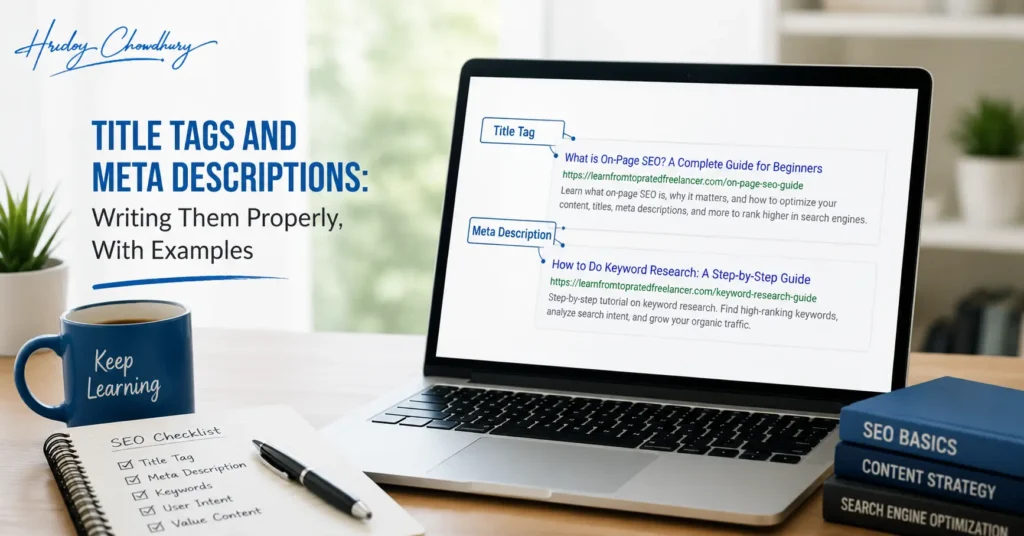
The title tag is one of the clearest relevance signals on the page, and it’s also the first thing, sometimes the only thing, a searcher reads before deciding whether to click. A technically perfect page with a vague or generic title still loses clicks to a weaker page with a title that speaks directly to what the searcher wants. The meta description doesn’t influence ranking position directly, but it directly influences click-through rate at whatever position you do rank, and a low click-through rate relative to your position is itself a signal search engines can factor into how the page performs over time.
I treat both as part of the actual content, written with the same care as a headline, not an administrative field filled in last.
Writing title tags properly
Put the keyword in naturally, near the front where possible
Search engines still weight terms that appear earlier in the title somewhat more heavily, and searchers scanning results tend to notice the front of a title first. This doesn’t mean forcing an awkward keyword-first phrase. It means writing a natural sentence where the keyword sits early because that’s genuinely where it belongs.
Describe the actual page, not a category
“SEO Services” tells a searcher almost nothing about what makes this specific page worth clicking over the ten other “SEO Services” titles on the same results page. “Technical SEO Audits for Ecommerce Sites | London” tells them exactly what they’re getting and who it’s for.
Keep it under roughly 60 characters
Google doesn’t enforce a strict character limit, it’s actually based on pixel width, but 50 to 60 characters is a safe practical range that avoids truncation on most screens. If your title gets cut off mid-word in search results, it looks unfinished and reads as less trustworthy, even though nothing is technically wrong with the page itself.
Avoid keyword stuffing
“Running Shoes, Buy Running Shoes, Cheap Running Shoes Online” reads as spam to a human and doesn’t help with modern search engines the way it might have fifteen years ago. One clear instance of the keyword, in a natural sentence, outperforms repetition.
Differentiate near-duplicate pages
If your site has multiple similar pages, several product variants, several city-specific service pages, each title needs something that distinguishes it, the specific product, the specific city, the specific angle. Identical or near-identical titles across pages make it harder for search engines to understand which page to show for which search, and harder for a searcher scanning multiple results from your own site to tell them apart.
Title tag examples: before and after
Bakery, product category page Before: “Cakes – Sweet Treats Bakery” After: “Custom Birthday Cakes in Manchester | Sweet Treats Bakery” The before version is generic and could describe almost any bakery’s cake page anywhere. The after version tells a searcher exactly what’s available and where.
SaaS company, feature comparison page Before: “Compare Plans” After: “TaskFlow vs Asana: Feature and Pricing Comparison (2026)” The before version doesn’t even name the product or the comparison, so it means nothing outside the context of already being on the site. The after version works as a standalone search result and matches how someone would actually search for this comparison.
Local service business Before: “Home | ABC Plumbing” After: “Emergency Plumber in Leeds, Available 24/7 | ABC Plumbing” The before version wastes the most valuable text on the page. The after version leads with exactly what a searcher in urgent need is looking for.
Blog post, informational content Before: “Blog Post #47” After: “How to Unclog a Drain Without Calling a Plumber” This sounds like an obvious fix, and it is, but auto-generated or placeholder titles like the before version show up far more often than you’d expect, particularly on sites where content was migrated from an older platform without anyone checking the result.
Writing meta descriptions properly
Treat it as a pitch, not a summary
A meta description’s job is to earn the click, not to restate the title in slightly different words. Give the searcher a specific, honest reason this page answers what they’re looking for, ideally including a concrete detail, a number, a specific benefit, that a generic description wouldn’t include.
Match the intent of the searcher
A description for a transactional page should point toward the action, pricing, availability, what happens next. A description for an informational page should hint at the specific answer or structure inside, not just restate that the topic will be discussed.
Keep it under roughly 155 characters
Similar to titles, this isn’t a hard technical limit but a practical one based on how much text search engines typically display before truncating. Google will sometimes generate its own description from the page content instead of using yours if it decides your version doesn’t match the query well, so writing one that’s genuinely relevant and specific also improves the odds Google actually uses it.
Avoid vague filler
“Learn more about our services and how we can help your business today” could sit under literally any company’s homepage in any industry. It gives a searcher no actual reason to choose this result over the next one.
Meta description examples: before and after
Bakery, product category page Before: “We make delicious cakes for every occasion. Contact us today to learn more.” After: “Custom birthday cakes made fresh in Manchester, ready in 48 hours. Browse designs or request a free quote.” The after version includes specifics, location, turnaround time, a clear next step, that the before version entirely lacks.
SaaS comparison page Before: “Compare features and pricing between two popular project management tools.” After: “TaskFlow starts at $9/user vs Asana’s $10.99/user. See the full feature breakdown before you switch.” The after version leads with a concrete, useful fact a comparison shopper genuinely wants, which is exactly the kind of specific detail that earns a click over a generic competitor description.
Local service business Before: “ABC Plumbing offers professional plumbing services in the area.” After: “Burst pipe or blocked drain? ABC Plumbing answers 24/7 in Leeds, most callouts within the hour.” The after version speaks directly to the urgency behind the likely search, rather than describing the business in the abstract.
A mistake I still see on otherwise well-built sites
Leaving the meta description blank and letting Google auto-generate one from the page content. This isn’t catastrophic, Google’s auto-generated versions are usually coherent, but they’re pulled from whatever text on the page seems most relevant to the specific query, which means the same page can show a different, unpredictable description depending on the search. Writing your own gives you a consistent, deliberate pitch instead of leaving it to chance.
What good titles and descriptions can’t do
A strong title and description earn more clicks at whatever position you’re already ranking in. They don’t move that position on their own, and they won’t rescue a page that doesn’t actually match the searcher’s intent once they land on it. If people are clicking through and immediately leaving, the fix is usually on the page itself, not in these two fields.
Where this fits in the bigger picture
Title tags and meta descriptions are part of the on-page fundamentals covered in the full SEO for beginners guide, sitting alongside heading structure, internal linking and content quality. If you want feedback on your actual titles and descriptions, not just examples from other industries, that’s part of what the SEO Masterclass works through directly on your own pages.
About Hridoy Chowdhury: Hridoy Chowdhury is a London-based Top Rated Plus SEO Consultant with 7+ years of experience and 3,500+ completed SEO projects. He specializes in SEO, Technical SEO, Local SEO, Ecommerce SEO, AEO, GEO, Entity SEO and AI Search Optimization. He also shares practical SEO education through his YouTube channel and has trained more than 50,000 learners.